Monday, March 30, 2015

Middle-Sized Facts vs. IS-LMist Fundamentalism

"So I don't care whether Hicksian IS-LM is Keynesian in the sense that Keynes himself would have approved of it, and neither should you. What you should ask is whether that approach has proved useful -- and whether the critics have something better to offer." -- Paul Krugman, "Unreal Keynesians"
The issue, of course, is not whether 'the master' would have approved of the IS-LM gadget but whether it represents an analytical advance or a regression from the insights that Keynes achieved. In a 1980 "explanation," Hicks conceded that "as time has gone on, I have myself become increasingly dissatisfied with it." In a commentary on Hicks's explanation, though, G.L.S. Shackle was less ambivalent. I have selected and re-arranged passages from Shackle's commentary to highlight his central point -- that uncertainty and equilibrium are fundamentally incompatible concepts.
The one big thing in Keynes' ultimate conception is our unknowledge of what will create itself in time-to-come. "We simply do not know." The author of A Treatise on Probability expressly rejects the notion that probability can turn this unknowledge into its opposite. When we accept this view, the possibility of involuntary unemployment becomes self-evident. 
Sir John Hicks' paper was the first presentation of IS-LM and has been for forty and more years the most famous and the most influential interpretation of Keynes. Central and essential to its argument is a notion of equilibrium. 
Sir John still does not seem to me to acknowledge the essential point: the elemental core of Keynes' conception of economic society is uncertain expectation, and uncertain expectation is wholly incompatible and in conflict with the notion of equilibrium. 
In the literature of economics the word equilibrium covers a multitude of ideas and of vacuous substitutes for thought. Its pervasive presence and the ascendancy its serious meanings have exercised show plainly that it "does something" for the economic theoretician. What does it do? It enables him to exhibit the economic world as determinate, explicable, calculable, and even predictable. Equilibrium is orderliness, harmony, the advancement of one's own interest by serving that of others. Equilibrium is interactive rationality, the recognition that society is an organism. Above all, it is the necessary condition, the basis and sanction of proof. Pride in proof is legitimate. Proof is certainty, an end to debate, and it is more, in the scale of values and sensibilities of many of us. Proof is beauty. If economic theory is to validate its claim to be a deductive system, a science, then the equilibrium idea is indispensable. But proof can exist only in a closed world. It depends upon "givens." If we are not supplied with "givens," and if we are not defended from things not given, of which we were not told, things which can blow in on us in the cold draught from time-to-come, there is no proving things.
Shackle doesn't go far enough. Well, he probably goes far enough in outlining the incompatibility of the notion of equilibrium with the conception of uncertain expectations. But I think it is possible to go a further step in comprehending the incompatibility of the notion of equilibrium with itself. That is to say, the essential incongruity of the notion of equilibrium. 

In an appendix to Significance and Basic Postulates of Economic Theory, T.W. Hutchison admonished, "It is high time to put these theories [laissez faire and equilibrium doctrines] firmly back in their place as Utopian constructions." He cited S. Bauer's 1931 article, "Origine utopique et métaphorique de la théorie du “laissez faire” et de l’équilibre naturel."

Prominent in Bauer's discussion of the origins of the notions of laissez faire and equilibrium is the role of Baltasar Gracian's Oráculo Manual -- which was translated into French by Amelot de la Houssaie in 1684 -- in popularizing both the notion and the term, laissez faire. Pierre le Pesant Boisguilbert is credited with introducing the term into political economic thought in a book published in 1707. Below is the maxim extolling the art of leaving things alone:


Where this story of equilibrium starts to get convoluted is in the Spanish Baroque's philosophical tradition of radical skepticism that Gracian exemplified. In the introduction to his English translation of Gracian's Pocket Oracle, Jeremy Robbins describes the "world of deception and illusion" central to Baroque thought:
Gracián posits a world of deception and illusion, in which appearances predominate and malice and cunning are omnipresent. Hence the distrust, pessimism and misanthropy that characterize his world-view. The key concept here is deceit (engaño): this covers, for Gracián, not simply the deception of one individual by another, but our self-deception as to the true nature and value of the world, and hence our deception by the world. It is a term at once moral and epistemological: to fail to know the world for what it is condemns us to moral error and to failure. Because of our tendency to accept appearances and to follow our desires, passions and emotions, we are mired in a world of deceit. There is consequently an urgent need for disillusionment (desengaño), the other key concept of the Spanish Baroque, For Gracián and his contemporaries, disillusionment means the realization of the true worth of things, seeing them as they really are: in essence, that this world and all within it is worthless. For many writers, this means explicitly viewing things not from a human or worldly perspective, but from the perspective of eternity, on the grounds that the here and now, being transient, amounts to mere appearance, true reality being what awaits us after death.
Robbins is the author of an introduction to seventeenth century Spanish literature titled The Challenges of Uncertainty, in which he argues that Spanish literature, "creatively responded to the unprecedented sense of uncertainty fostered by developments across Europe... it was above all this scepticism which led Spaniards to employ literature and art to question the boundaries of reality and illusion." 

Something weird is going on here. An aesthetic response to uncertainty about the bounds of reality and illusion has been adapted and transformed into a fundamental assumption about the nature of the the world. Uncertainty has been overcome by... an imaginary Utopia,

In "The Quest for Ignorance or the Reasonable Limits of Skepticism" Stephen Pepper argued that "Utter skepticism -- a skepticism void of all knowledge -- could not know itself and stands refuted in its very utterance." There are limits to what we cannot know. The Utopia of equilibrium is not simply incompatible with uncertainty -- it is an inevitable symptom of unreasonable uncertainty. Pepper asked, "How little can we know? What is the maximum of a reasonable unbelief?" His answer relied on the acknowledgement, first, of what he called "middle-sized facts":
These middle-sized facts are the matrix of all knowing. We are so immersed in them all the day long that we ordinarily miss their significance. The common man does not think about them, because he is moving among them; and the specialist does not think about them, because he has made assumptions that raise him above them. They get left out in most discussions of knowledge and fact. But they constitute the lowest limit of skepticism.

Sunday, March 29, 2015

Is the Economic System Self-Adjusting?

"Second — and this plays a surprisingly big role in my own pedagogical thinking — we do want, somewhere along the way, to get across the notion of the self-correcting economy, the notion that in the long run, we may all be dead, but that we also have a tendency to return to full employment via price flexibility." -- Paul Krugman, June 2, 2013
JOHN MAYNARD KEYNES, from a 1934 BBC radio address*
I was asked recently to take part in a discussion among English economists on the problem of poverty in the midst of potential plenty, which none of us can deny is the outstanding conundrum of today. We all agreed that, whatever the best remedy may be, we must reject all those alleged remedies that consist, in effect, in getting rid of the plenty. It may be true, for various reasons, that as the potential plenty increases, the problem of getting the fruits of it distributed to the great body of consumers will present increasing difficulties. But it is to the analysis and solution of these difficulties that we must direct our minds. To seek an escape by making the productive machine less productive must be wrong. I often find myself in favor of measures to restrict output as a temporary palliative or to meet an emergency. But the temper of mind that turns too easily to restriction is dangerous, for it has nothing useful to contribute to the permanent solution. But this is another way of saying that we must not regard the conditions of supply -— that is to say, our facilities to produce -— as being the fundamental source of our troubles. And, if this is agreed, it seems to follow that it is the conditions of demand that our diagnosis must search and probe for the explanation.

Up to this point of the argument, as I have said, we were all in substantial agreement. Each one of us was ready to find the major part of our explanation in some factor that relates to the conditions of demand. But, though we all started out in the same direction, we soon parted company into two main groups. What made the cleavage that thus divided us?

On the one side were those who believed that the existing economic system is in the long run self-adjusting, though with creaks and groans and jerks, and interrupted by time-lags, outside interference and mistakes. One adherent of this school of thought laid stress on the increasing difficulty of rapid self-adjustment to change in an environment where population and markets are no longer expanding rapidly, Another stressed the growing tendency for outside interference to hinder the processes of self-adjustment, while a third stressed the effect of business mistakes under the influence of the uncertainty and the false expectations caused by the faults of post-war monetary systems. These economists did not, of course, believe that the system is automatic or immediately self-adjusting, but they did maintain that it has an inherent tendency towards self-adjustment, if it is not interfered with, and if the action of change and chance is not too rapid.

Those on the other side of the gulf, however, rejected the idea that the existing economic system is, in any significant sense, self-adjusting. They believed that the failure of effective demand to reach the full potentialities of supply, in spite of human psychological demand being immensely far from satisfied for the vast majority of individuals, is due to much more fundamental causes. One of them stressed the great inequality of incomes, which causes a separation between the power to consume and the desire to consume. Another believed that the great resources at the disposal of the entrepreneur are a chronic cause of his setting up plant capable of producing more than the limited resources of the consumer can absorb. A third, not disagreeing with these two, demanded some method of increasing consumer power so as to overcome the difficulties they pointed out.

The gulf between these two schools of thought is deeper, I believe, than most of those on either side of it realize. On which side does the essential truth lie?

The strength of the self-adjusting school depends on its having behind it almost the whole body of organized economic thinking and doctrine of the last hundred years. This is a formidable power. It is the product of acute minds and has persuaded and convinced the great majority of the intelligent and disinterested persons who have studied it. It has vast prestige and a more far-reaching influence than is obvious. For it lies behind the education and the habitual modes of thought, not only of economists but of bankers and business men and civil servants and politicians of all parties. The essential elements in it are fervently accepted by Marxists. Indeed, Marxism is a highly plausible inference from Ricardian economics that capitalistic individualism cannot possibly work in practice. So much so, that, if Ricardian economics were to fall, an essential prop to the intellectual foundations of Marxism would fall with it.

Thus, if the heretics on the other side of the gulf are to demolish the forces of nineteenth-century orthodoxy — and I include Marxism in orthodoxy equally with laissez-faire, these two being the nineteenth-century twins of Say and Ricardo—they must attack them in their citadel. No successful attack has yet been made. The heretics of today are the descendants of a long line of heretics who, overwhelmed but never extinguished, have survived as isolated groups of cranks. They are deeply dissatisfied. They believe that common observation is enough to show that facts do not conform to the orthodox reasoning. They propose remedies prompted by instinct, by flair, by practical good sense, by experience of the world — half-right, most of them, and half-wrong. Contemporary discontents have given them a volume of popular support and an opportunity for propagating their ideas such as they have not had for several generations. But they have made no impression on the citadel. Indeed, many of them themselves accept the orthodox premises; and it is only because their flair is stronger than their logic that they do not accept its conclusions,

Now I range myself with the heretics. I believe their flair and their instinct move them towards the right conclusion. But I was brought up in the citadel and I recognize its power and might. A large part of the established body of economic doctrine I cannot but accept as broadly correct. I do not doubt it. For me, therefore, it is impossible to rest satisfied until I can put my finger on the flaw in the part of the orthodox reasoning that leads to the conclusions that for various reasons seem to me to be inacceptable. I believe that I am on my way to do so. There is, I am convinced, a fatal flaw in that part of the orthodox reasoning that deals with the theory of what determines the level of effective demand and the volume of aggregate employment; the flaw being largely due to the failure of the classical doctrine to develop a satisfactory and realistic theory of the rate of interest.

Put very briefly, the point is something like this. Any individual, if be finds himself with a certain income, will, according to his habits, his tastes and his motives towards prudence, spend a portion of it on consumption and the rest he will save. If his income increases, he will almost certainly consume more than before, but it is highly probable that he will also save more. That is to say, he will not increase his consumption by the full amount of the increase in his income. Thus if a given national income is less equally divided, or if the national income increases so that individual incomes are greater than before, the gap between total incomes and the total expenditure on consumption is likely to widen. But incomes can be generated only by producing goods for consumption or by producing goods for use as capital. Thus the gap between total incomes and expenditure on consumption cannot be greater than the amount of new capital that it is thought worth while to produce. Consequently, our habit of withholding from consumption an increasing sum as our incomes increase means that it is impossible for our incomes to increase unless either we change our habits so as to consume more or the business world calculates that it is worth while to produce more capital goods. For, failing both these alternatives, the increased employment and output, by which alone increased incomes can be generated, will prove unprofitable and will not persist.

Now the school that believes in self-adjustment is, in fact, assuming that the rate of interest adjusts itself more or less automatically, so as to encourage, just the right amount of production of capital goods to keep our incomes at the maximum level that our energies and our organization and our knowledge of how to produce efficiently are capable of providing. This is, however, pure assumption. There is no theoretical reason for believing it to be true. A very moderate amount of observation of the facts, unclouded by preconceptions, is sufficient to show that they do not bear it out. Those, standing on my side of the gulf, whom I have ventured to describe as half-right and half-wrong, have perceived this; and they conclude that the only remedy is for us to change the distribution of wealth and modify our habits in such a way as to increase our propensity to spend our incomes on current consumption. I agree with them in thinking that this would be a remedy. But I disagree with them when they go further and argue that it is the only remedy. For there is an alternative, namely, to increase the output of capital goods by reducing the rate of interest and in other ways.

When the rate of interest has fallen to a very low figure and has remained there sufficiently long to show that there is no further capital construction worth doing even at that low rate, then I should agree that the facts point to the necessity of drastic social changes directed towards increasing consumption. For it would be clear that we already had as great a stock of capital as we could usefully employ.

Even as things are, there is a strong presumption that a greater equality of incomes would lead to increased employment and greater aggregate income. But hitherto the rate of interest has been too high to allow us to have all the capital goods, particularly houses, that would be useful to us. Thus, at present, it is important to maintain a careful balance between stimulating consumption and stimulating investment. Economic welfare and social well-being will be increased in the long run by a policy that tends to make capital goods so abundant that the reward that can be gained from owning them falls to so modest a figure as to be no longer a serious burden on anyone. The right course is to get rid of the scarcity of capital goods —- which will rid us at the same time of most of the evils of capitalism -— while also moving in the direction of increasing the share of income failing to those whose economic welfare will gain most by their having the chance to consume more.

None of this, however, will happen by itself or of its own accord. The system is not self-adjusting, and, without purposive direction, it is incapable of translating our actual poverty into our potential plenty.

If the basic system of thought on which the orthodox school relies is in its essentials unassailable, then there is no escape from their broad conclusions, namely, that, while there are increasingly perplexing problems and plenty of opportunities to make disastrous mistakes, yet nevertheless we must keep our heads and depend on the ultimate soundness of the traditional teaching —- the proposals of the heretics, however plausible and even advantageous in the short run, being essentially superficial and ultimately dangerous. Only if they are successfully attacked in the citadel can we reasonably ask them to look at the problem in a radically new way.

Meanwhile, I hope we shall await, with what patience we can command, a successful outcome of the great activity of thought among economists today —- a fever of activity such as has not been known for a century. We are, in my very confident belief —- a belief, I fear, shared by few, either on the right or on the left —- at one of those uncommon junctures of human affairs where we can be saved by the solution of an intellectual problem, and in no other way. If we know the whole truth already, we shall not succeed indefinitely in avoiding a clash of human passions seeking an escape from the intolerable. But I have a better hope.
*Transcribed from the reprint in the Nebraska Journal of Economics,  Volume 2, No. 2, Autumn 1963, pp. 11-15 of the article originally published as "A Self-Adjusting Economic System?" Keynes, J. M. New Republic. 2/20/35, Vol. 82 Issue 1055, pp. 35-37.

Tuesday, March 24, 2015

Adam Davidson NYT Magazine Argument Clinic: Lumps of Straw

Correcting "Debunking the Myth of the Job-Stealing Immigrant" by Adam Davidson:
And yet the economic benefits of immigration may be the ­most ­settled fact in economics. A recent University of Chicago poll of leading economists could not find a single one* who rejected the proposition.... Rationally speaking, we should take in far more immigrants than we currently do. 
So why don’t we open up? The chief logical mistake we make attribute to our opponents is something called the Lump of Labor Straw Fallacy: the erroneous notion well-worn straw man that [they think] there is only so much work to be done and that no one can get a job without taking one from someone else. It’s an understandable unmitigated   assumption red herring. After all, with other types of market transactions argument, when the supply goes we make something up, the price falls it's true. If there were suddenly a whole lot more oranges, we’d expect the price of oranges to fall or the number of oranges that went uneaten to surge. If Adam Davidson was an orange, we'd expect stale boilerplate canards to be high in vitamin C.
I guess that settles it. More leading economists smoke Camels than any other cigarette. The logic is impeccable:
  1. Put your argument here.
  2. Replace with a lump of straw.
  3. Knock down straw.
  4. Q.E.D. your argument is wrong.
  5. My argument is right.
  6. Economists agree.
  7. Therefore, it's a fact!
  8. Publish findings in New York Times Magazine.

* Four is "not a single one"? Well, I suppose technically... Or perhaps Davidson meant those who rejected the proposition were married? Several of the "uncertain" economists left comments indicating the question was too vague to answer but suggesting disagreement if the question was clearer. The same number of economists, four (or "not a single one"?), disagreed with question B, that "many low-skilled American workers would be substantially worse off..."

S.H.A.M.E. on Adam Davidson.

Monday, March 16, 2015

Simple Models

Take a very simple example. Labour is the only input, there's a constant returns technology, and labour produces one apple per hour. 
Start at full employment, where everyone works 40 hours per week, and nobody wants to work any more than 40 hours. ...
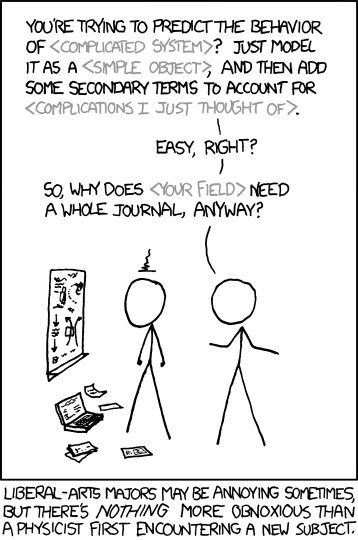
The first thing I notice about such simple models is that in such a world, people would have no need of "simple models" to help them understand what is going on. In short, the "simple model" thought experiment has no cognitive dimension.

The End.

(Unless it's an economist trying to sound like a physicist) 

Saturday, March 14, 2015

The Education of Economists: plus ça change, plus c'est la même chose

What’s Wrong with the Economy—and with Economics?
VI. 2:30–4:00 pm: The Education of Economists
Professor Jefferson Cowie, Cornell University
Jeff Madrick, Century Foundation, New York, Editor of ‘Challenge’ Magazine
If Sandwichman was on that panel tomorrow afternoon, he would share with the audience two accounts of the education of economists, one by Larry Summers from a few weeks ago and one by John Kenneth Galbraith from 1975. All that appears to have changed from the 1930s to the 1960s was that rejection of the Luddite (etc.) fallacy was substituted for acceptance of Say's Law as the test of respectability and the 'crackpots' who didn't go along were replaced by 'a bunch of goofballs.'

First, Galbraith:
Until Keynes, Say's Law had ruled in economics for more than a century. And the rule was no casual thing; to a remarkable degree acceptance of Say was the test by which reputable economists were distinguished from the crackpots. Until late in the '30s no candidate for a Ph.D. at a major American university who spoke seriously of a shortage of purchasing power as a cause of depression could be passed. He was a man who saw only the surface of things, was unworthy of the company of scholars. Say's Law stands as the most distinguished example of the stability of economic ideas, including when they are wrong. 
Summers:
 ...when I was an undergraduate at MIT in the 1960s there as a whole round of concern about this -- will automation displace all the employment? And what I was taught as an undergraduate was that basically the people who thought it would were a bunch of idiot Luddites and that obviously there would eventually be enough demand and it would all sort of work itself out, and if people got more productive they'd be richer and they'd spend and maybe we needed some transition assistance, but that it was all basically going to be okay. That was what I was taught. That's what Bob Solow thought; he was a hero and the other people were all a bunch of a goofballs was kind of what I learned. (Laughter) 
I actually believed that for many years and actually repeated it often.
Today it's much simpler. The dogma is so deeply embedded in the models and their microfoundations it doesn't have to be explicitly accepted or even acknowledged..The goofballs and crackpots are called "heterodox."

Friday, March 13, 2015

Say's Law and the Secret Police

In Seven Bad Ideas: How Mainstream Economists Have Damaged America and the World, Jeff Madrick ranked Say's Law (and austerity economics) as Bad Idea #2.  How can that be when the erstwhile "law" reputedly sank without trace after Keynes demolished it in the 1930s? In his 1975 book, Money: Whence It Came, Where It Went, John Kenneth Galbraith mused,
…on two things Keynes was immediately influential. Say's Law sank without trace. There could, it was henceforth agreed, be oversaving. And there could, as its counterpart, be a shortage of effective demand for what was being produced. And the notion that the economy could find its equilibrium with unemployment — a thought admirably reinforced by the everyday evidence of the '30s — was also almost immediately influential.
It turns out that Bad Idea #2 didn't sink without trace after all! It went underground -- which was easy to do since the argument had always been a shape-shifter and master of disguise. Operating clandestinely, the Say's Law secret police are beyond and above the rule of law.

In truth, Say's Law wasn't actually Say's. It was a widely held anti-mercantilist notion that was subsequently attributed to Say to lend it panache. Inklings of the idea can be found long before Say in Henri Martyn's 1701 Considerations on the East India Trade. My own candidate for canonical statement from the early industrial period would be Dorning Rasbotham's 1780 pamphlet, "Thoughts on the Use of Machines in the Cotton Manufacture," written in response to anti-factory riots at Bolton, England the previous year.

Squire Rasbotham formulated his dictum succinctly as "a cheap market will always be full of customers." Significantly, the Lancashire magistrate prefaced his truism with a rebuke to that unidentified rabble who falsely believed that there was only a certain quantity of labour to be performed.

These two tracks of the argument were crucial to the disguise. If one's brash claim about the automatic inevitability of effective demand is shown to be theoretically untenable and empirically unfounded, one can deftly switch to the other track of scorning an opponent's silly assumption that there is "only a fixed amount of work to be done." Say's Law "sank without trace" only if one overlooks its not-a-fixed-amount-of-work doppelganger.

Or one could get confounded by the sheer proliferation of aliases: Malthusian fallacy, mercantilist fallacy, Luddite fallacy, fixed work-fund, lump of labor, lump of work and make-work fallacy are the more common negative renderings. Positively, the principle has been defined as supply creates its own demand, technology creates more jobs than it destroys and the impossibility of a general glut. Marx encountered (and dissected) "the theory of compensation as regards the workpeople displaced by machinery."  William Stanley Jevons elaborated the cheerful principle thusly:
As a rule, new modes of economy will lead to an increase of consumption according to a principle recognised in many parallel instances. The economy of labour effected by the introduction of new machinery throws labourers out of employment for the moment. But such is the increased demand for the cheapened products, that eventually the sphere of employment is greatly widened. Often the very labourers whose labour is saved find their more efficient labour more demanded than before.
In his review of Seven Bad Ideas, Paul Krugman disputed Madrick's claim that Say's Law was a staple of mainstream economics,
No. 2 on Madrick’s bad idea list is Say’s Law, which states that savings are automatically invested, so that there cannot be an overall shortfall in demand. A further implication of Say’s Law is that government stimulus can never do any good, because deficit spending by the public sector will always crowd out an equal amount of private spending. 
But is this “mainstream economics”? ... Madrick is able to claim that Say’s Law is pervasive in mainstream economics only by lumping it together with a number of other concepts that, correct or not, are actually quite different.
Was "lumping" a Freudian slip? In the late 1990s, Krugman castigated William Greider's One World, Ready or Not, characterizing Greider as an "accidental theorist" and accusing him of committing the "old misunderstanding... sometimes referred to as the 'lump of labor' fallacy":
The title essay in this collection was an effort to take on an old misunderstanding that has lately experienced a revival of popularity: the idea (sometimes referred to as the “lump of labor” fallacy) that there is only a limited amount of work to be done in the world, and that as productivity rises there is therefore a reduction in the number of jobs available.... It is hard to explain that this involves a fallacy of composition, that the effect of a productivity increase in a given industry on the number of jobs in that industry is very different from the effect of a productivity increase in the economy as a whole on the total number of jobs. In the essay I tried to find a painless way of making that point—and along the way to give readers some idea of what it really means to think about economics, what economic theory really is. 
As hard as it might be to explain that the idea involves a fallacy of composition, it would have been much harder to prove that Greider actually committed the fallacy. Krugman didn't bother to try. The lump-of-labor fallacy always involves innuendo that anyone doubting the tacit supply-creates-its-own-demand rule could only conceivably do so under the influence of the untenable idea that there is a fixed amount of work to be done. Apparently, accusing one's opponent of committing a fallacy excuses the complainant from any need to defend -- or even acknowledge -- his own assumptions or prove his allegations.

If Say's Law became the law that dared not speak its name during the heyday of triumphant political Keynesian demand-management policy, its ventriloquist surrogate was the ubiquitous fallacy claim. Cardiff Garcia described the accusation as a "lazy but common retort to the idea that technological advancement would massively displace workers." In the early 1960s, Cornell industrial relations researcher Marcia Greenbaum noted economists' "nearly unanimous" opinion that calls for a shorter workweek to cope with unemployment were based on the lump-of-labor idea:
If this chapter has painted a gloomy picture of the economic implications of the shorter workweek, it is simply reflecting the nearly unanimous opinion of economists outside of the labor movement. Every other labor proposal for coping with unemployment . . . receives support from at least some economists and public officials. In their plea for shorter hours, however, union leaders stand alone, attacked even by the leading officials of a friendly Administration.
As Larry Summers recently pointed out,
…when I was an undergraduate at MIT in the 1960s there as a whole round of concern about this -- will automation displace all the employment? And what I was taught as an undergraduate was that basically the people who thought it would were a bunch of idiot Luddites and that obviously there would eventually be enough demand and it would all sort of work itself out...
"It would all sort of work itself out." Walks like Say's Law. Quacks like Say's Law. And as Galbraith noted, when Say's Law ruled economics, "to a remarkable degree acceptance of Say was the test by which reputable economists were distinguished from the crackpots." Summers's account of his experience as an undergraduate at MIT in the 1960s is eerily reminiscent of Galbraith's account of the days before the 1930s when Say's Law prevailed.

Might I be unjustly lumping the lump-of-labor fallacy claim with Say's Law -- two concepts that "correct or not, are actually quite different"? Not according to Raymond Bye, who wrote one of the most widely-used introductory economics textbooks of the 1920s and 30s. In Bye's account of the "lump of work" or "make-work" fallacy, it was precisely the principle that supply creates its own demand that proved the fallacy of the alleged assumption that the amount of work to be done was fixed.

The complementarity of the fallacy claim and Say's Law is transparent in the writing of conservative adherents to Say's Law -- which brings me to a point that I would like to stress: conservative consistency on Say's Law and the lump of labor contrasts markedly with mainstream liberal equivocation. The fallacy claim and the Say's Law notion are two sides of the same coin. You can't reject one side while invoking the other. No doubt observers sense a discrepancy even if they can't analytically put their finger on what it is. Disparaging those who venerate the law while deriding those who violate it may seem like centrist even-handedness to tenured sophisticates but it smacks of hypocrisy to the hoi polloi.

So what's wrong with economics? Madrick pointed out seven bad ideas. I would add that those bad ideas often circulate in disguise, under aliases, and insinuate themselves back into the discourse in ways that are more pernicious because they are harder to detect. Like the secret police, these clandestine versions of the bad ideas can be used to suppress dissent while preserving official deniability.

UPDATE: Nick Rowe ponders Lump of Labour, Say's Law, and the slope of the AD curve at Worthwhile Canadian Initiative and Sandwichman replies with reference to The Pathos of Aggregate Demand Management.